
FairPlay Exchange — Real Lay Exposure Worked Out on a ₹100 Slip
On the FairPlay exchange you take a side of the price instead of accepting a bookmaker's number. Tap the back cell to say an outcome happens, tap the lay cell to say it will not, and the slip shows how much of your balance gets held before you confirm. Further down, one ₹100 lay at 2.5 is worked through line by line.

FairPlay Exchange Login — Secure Slip With Mobile, Password and One OTP
Signed in, the FairPlay exchange opens with two figures pinned above the odds: balance and exposure. On a fresh ₹500 top-up the second one reads zero. It will not stay there once you lay anything, so this is the slip to keep an eye on.
FairPlay Exchange Back and Lay Cells — Live Prices Set by Players
Static mock for this page. Real FairPlay prices move with every ball.
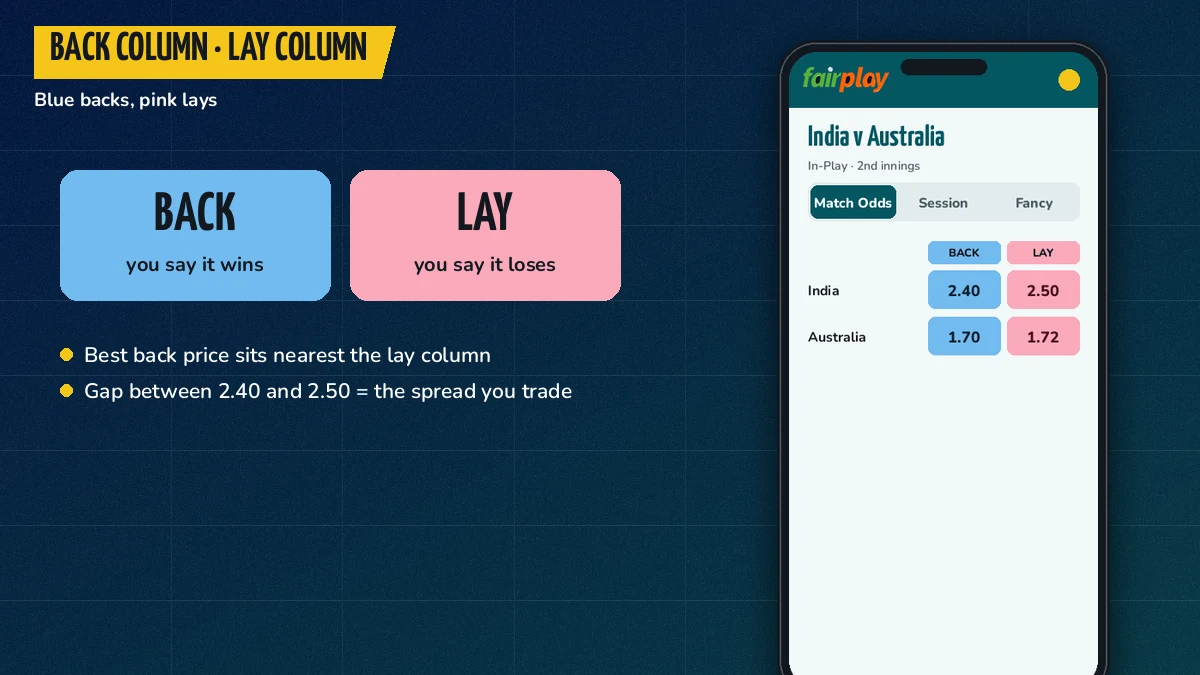
Two columns sit next to each runner on the FairPlay exchange. The back cell carries the best price another player will lay to you, and the small rupee figure under it is how much money is is waiting at that price. The lay cell is the reverse: the best price a backer wants, with the amount they have queued. You are always trading against a person on the other side, which is why FairPlay takes no bookmaker margin out of the price itself.In practice the gap beteen the two cells is narrow on a busy cricket match and wider on a quiet one.
/p>| On FairPlay | Back cell | Lay cell |
|---|---|---|
| What you are saying | This side wins | This side does not win |
| Stake box means | Your own money on it | The backer's stake you accept |
| Most you can lose | The stake | Stake × (odds − 1) |
| Best you can collect | Stake × (odds − 1) | The stake |
Read that table sideways and it is one bet seen from two chairs. Session and fancy lines work on their own yes/no logic, and they are covered on the FairPlay cricket markets page rather than here.
Worked FairPlay Exchange Lay: ₹100 at 2.5 Holds ₹150 of Real Exposure
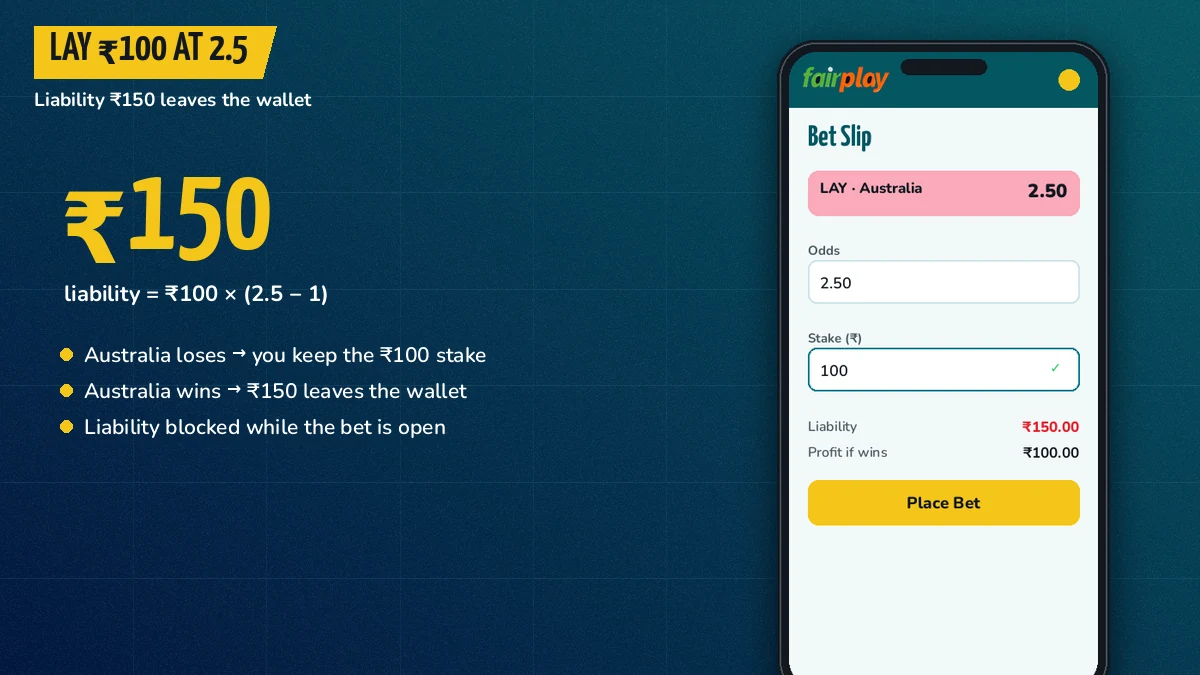
Numbers first. Say your FairPlay balance is ₹500, the minimum UPI top-up, and you think Side A is overpriced at 2.5.
- Tap 2.50 in the lay cell next to Side A. The FairPlay slip opens with that price already filled.
- Type 100 in the stake box. On a lay, this is the backer's money you are agreeing to take if Side A loses.
- Read the liability line before anything else: (2.5 − 1) × 100 = ₹150.
- Confirm. Exposure at the top of the FairPlay account moves from ₹0 to ₹150, and available balance falls from ₹500 to ₹350.
| If this happens | Your lay result | Balance after |
|---|---|---|
| Side A wins | − ₹150 | ₹350 |
| Side A does not win | + ₹100 (before commission) | ₹600 less commission |
So a ₹100 lay is not a ₹100 risk. At 2.5 it is a ₹150 risk for a ₹100 reward, and the higher the price you lay, the wider that gap gets. Put a ₹100 back bet at the same 2.5 next to it and the picture flips: ₹100 held, ₹150 possible profit.
A composite case the FairPlay desk sees often enough: someone lays an outsider at 4.0 with a ₹500 stake, thinking the damage is capped at ₹500. The slip says ₹1,500. With ₹1,000 in the wallet it simply refuses the bet, and the user assumes the site is broken.
It isn't. The FairPlay exchange won't let exposure run past what you hold, which is annoying for about ten seconds and useful for much longer.
Trading Out on the Live FairPlay Exchange After the Price Moves
Exposure is not fixed once a bet is on. Suppose you backed Side A for ₹100 at 2.5, then the price shortened to 2.0 during the chase. Laying ₹100 at 2.0 now gives you this: if Side A wins, +₹150 from the back and −₹100 from the lay, so +₹50; if Side A loses, −₹100 and +₹100, so zero. The losing side of the FairPlay market has been closed off, and your exposure there drops to nothing (equal stakes are the simple version; splitting the profit evenly across both outcomes needs a slightly different lay stake, roughly ₹125 here).
Official FairPlay Exchange Login and Lay Terms, Tab by Tab
Trusted FairPlay Exchange Words as They Appear on the Slip
Spelled fairplay exchange, fair play exchange with a gap, or typed as fairplay exchange login because the sign-in is what you need: every version lands on one FairPlay wallet in rupees, and the lay you place at 2.5 on the exchange draws on the same balance as a sportsbook bet.
If you do not have a FairPlay ID yet, the FairPlay register steps take one mobile number and an OTP, and the FairPlay ID explainer covers what that account number is used for.
Fast FairPlay Exchange Lay Maths, Cell by Cell
- FairPlay exchange
- Player-to-player market where you back or lay a runner at prices other members offer.
- FairPlay exchange login
- Mobile number or FairPlay ID plus password, OTP if enabled, the same credentials as the app.
- Back cell
- Price you take when you say an outcome happens; risk equals stake.
- Lay cell
- Price you take when you say it will not; risk equals stake × (odds − 1).
- Liability
- What a single lay can cost you. ₹100 at 2.5 = ₹150.
- Exposure
- Total held across open FairPlay bets, subtracted from available balance until settlement.
- Matched
- The part of your FairPlay stake already paired at your price. A ₹60 / ₹40 split means ₹40 is still queued.
- Commission
- Charged on net winnings in a market, not on losses.
Matched vs Unmatched FairPlay Exchange Bets — Real Commission Only on Net Win
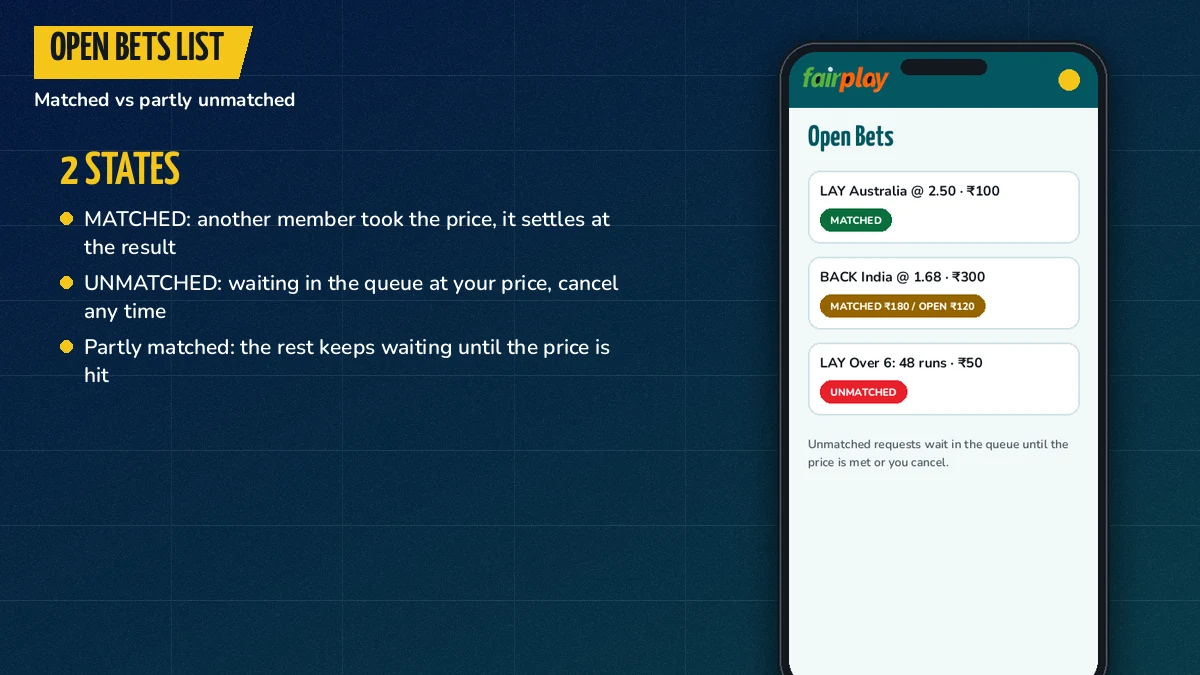
A FairPlay bet only counts once it is matched.
If you tap a price that is sitting in the cell, a player is already waiting there, and the bet matches straight away. Ask for something better than what is on offer, say, laying Side A at 2.3 while the lay cell still shows 2.5, and your request goes into the queue as unmatched. It stays there until a backer accepts 2.3, or you cancel it, or the market is suspended. Partial fills happen too: ₹60 matched and ₹40 still waiting is a normal sight on the FairPlay open-bets list, and it is easy to forget the the waiting part when the over ends.
Does an unmatched bet hold exposure? In practice, yes, the FairPlay wallet reserves the liability while it waits, so cancel stale requests if you want that balance back for something else. Because the wallet is shared, money locked on the exchange is also money you cannot take into a FairPlay casino table until it is released.
How the Live FairPlay Exchange Nets Exposure Across One Market
Exposure is worked per market, not per bet. Back Side A for ₹100 at 2.48 and Side B for ₹100 at 1.66 in the same match, and the FairPlay slip does not hold ₹200. It checks each result instead:
- Side A wins: +₹148 on the first bet, −₹100 on the second, so +₹48.
- Side B wins: −₹100 on the first, +₹66 on the second, so −₹34.
The worst line is −₹34, and that is the exposure you will see. Small, because the two bets mostly cancel. One more thing trips people up. Prices can move in the second or two between tapping a cell and confirming, and when that happens the FairPlay slip either matches at the new figure or parks the request as unmatched, depending on which way the price went. Glance at the open-bets list after a busy over. It takes five seconds.
Commission is the one charge on the FairPlay exchange, and it is worked on your net winnings per market. Win ₹100 on a lay, lose ₹40 on a back in the same match, and commission applies to the ₹60 you are up. Lose the market overall and there is nothing to pay. The exact rate sits in the market rules on the site; check it there rather then trusting a figure passed around in a group chat. Welcome-bonus money has its own wagering conditions, which the FairPlay bonus code page lays out.
FairPlay Exchange FAQ — Real Answers on Lay, Exposure and Commission
Is the FairPlay exchange a real player-to-player market?
Yes. On the FairPlay exchange every price in the back and lay cells comes from another member, not from a bookmaker. You pick a side, someone else takes the opposite side, and the money moves between the two of you once the market settles, with commission taken only from a net win.
How does a real-money lay work on the FairPlay exchange?
A lay says an outcome will not happen. On FairPlay you tap the lay cell, enter the backer's stake you accept, and the slip shows your liability. A ₹100 lay at 2.5 wins ₹100 if the outcome fails and costs ₹150 if it comes through.
What does exposure mean on the live FairPlay exchange?
Take a ₹500 FairPlay wallet and one ₹100 lay at 2.5. The exposure box now reads ₹150 and only ₹350 is free to use. That ₹150 is the worst result across the market, and it is released when the match settles or when you lay or back again to close it.
Does the official FairPlay exchange charge commission?
Yes, but only on net winnings in a market. If you finish a FairPlay market ahead, commission is taken from that profit; if you finish level or behind, you pay nothing. The current rate is listed in the market rules on the site, so check it there before you trade.
- fairplay exchange
- fairplay exchange login
- fair play exchange
- fairplay back and lay
- fairplay lay bet
- fairplay exchange exposure
- fairplay exchange commission
- fairplay live exchange
| FairPlay page | What sits there |
|---|---|
| FairPlay Cricket | Session, fancy and over lines |
| FairPlay Casino | Live dealer tables on the same wallet |
| FairPlay ID | What your account number is for |
| FairPlay Register | Mobile, password, OTP |
| FairPlay Bonus Code | Wagering on welcome money |
| FairPlay Login | Home sign-in and odds board |